



What is this project about?
This initiative brings together researchers, educators, technology experts, and institutions across Europe to explore the inclusive, ethical, and responsible use of artificial intelligence in pre-primary and primary education. The initiative focuses on embodied, playful, and developmentally appropriate learning for children aged 4–8. It aims to support computational thinking, STEM learning, participation, inclusion, and child well-being while strengthening—not replacing—teachers' professional role. The initiative is currently being developed through collaborative pedagogical design, technology planning, comparative research, and engagement with schools, kindergartens, teacher educators, and policymakers.
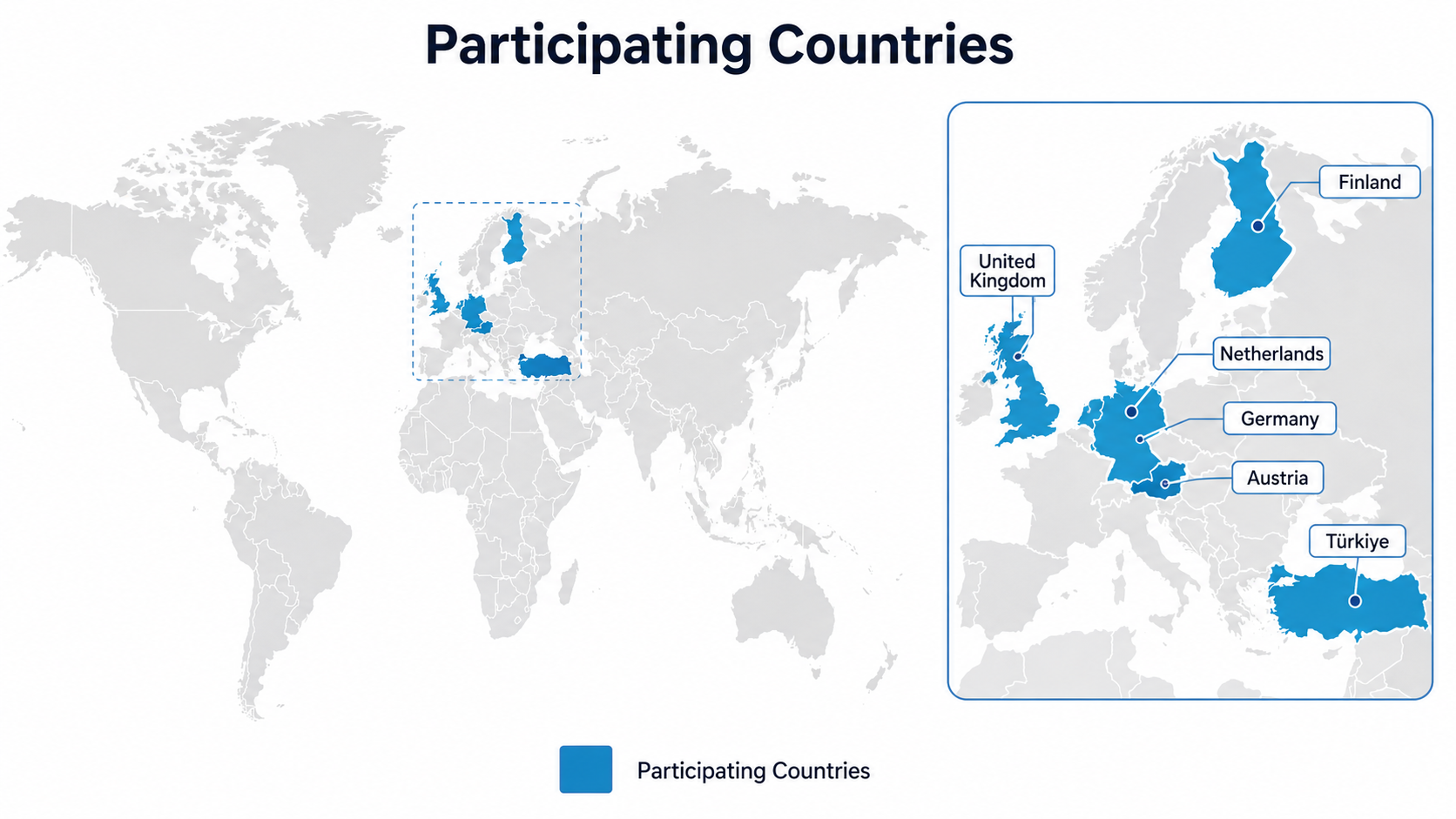
Participating and Prospective Partners:
The participating institutions contribute complementary expertise in early childhood and primary education, artificial intelligence, educational technology, computational thinking, STEM learning, teacher education, child development, and policy.
| Country | Institution | Team members | Main expertise or role |
Austria | University of Graz | Filiz Mumcu Lars Eichen Eva Pölzl-Stefanec Thomas Moser | Digitalization in early childhood education; early childhood education, teacher education; professional development; coordination of the initiative |
Türkiye | Middle East Technical University — METU | Refika Olgan Elif Buldu Erkan Er | Pre-primary and primary education; curriculum development; educational technology |
Germany | Leipzig University | Elisa Oppermann | Early childhood education; child development; learning processes; empirical research in early childhood settings |
United Kingdom | University College London — UCL | Manolis Mavrikis Yang Yang | Artificial intelligence in education; learning technologies; AI-supported learning environments |
Finland | University of Helsinki | Katja Maria Upadyaya | Cognition, learning, instruction, child well-being, inclusion, and educational evaluation |
The Netherlands | Delft University of Technology — TU Delft | Burak Sisman | Software development; educational technology; system design and implementation |
Austria | Johannes Kepler University Linz — JKU | Zsolt Lavicza Eva Schmidthaler Eva Ulbrich | STEAM education; AI in education; educational technology |
European and national level | Ministry or relevant policy organization | To be confirmed | Policy engagement; educational strategy; curriculum and policy alignment; support for systemic implementation |
Partner countries | Kindergartens and schools | Associated partners to be confirmed | Co-design; classroom implementation; piloting; validation; practitioner feedback; access to authentic educational settings |
Meeting Dates and Topics:
20 February 2026 — Initial Collaboration Meeting
Format: Online
Time: 11:00–13:00 CEST
Participants introduced their institutions, expertise, and areas of interest. The discussion focused on shared priorities for inclusive, ethical, and responsible AI in pre-primary and primary education, including embodied learning, playful learning, accessibility, teacher support, and the feasibility of different technological approaches. Particular attention was given to how AI could be integrated without replacing play, movement, social interaction, or teacher judgment. Participants discussed embodied AI as an alternative to predominantly screen-based interaction, the possible use of AI-supported smart learning spaces, and the establishment of laboratory-based environments at participating universities. Concerns were also raised about affordability, accessibility, technical feasibility, and the need to build on existing technologies rather than develop all components from the beginning.
20 April 2026 — Thematic Development Meeting
Format: Online
Time: 09:00–11:00 CEST
The meeting focused on pedagogical design, technology, evaluation, teacher education, and implementation. Participants discussed age-appropriate activity progression, low- and high-tech learning formats, teacher scaffolding, smart learning environments, evidence collection, and coordinating interdisciplinary contributions. The AI-related discussion addressed the possible architecture of an AI-supported learning environment, including computer vision or movement sensing, augmented or projected environments, smart-space hardware, adaptive learning interactions, and a teacher dashboard. Participants emphasized that the technological design should be driven by clearly defined pedagogical goals and realistic classroom needs. The group also discussed how AI might support teachers by making participation and learning processes more visible, providing formative feedback, and reducing the workload associated with observation and documentation. At the same time, participants stressed the importance of technical feasibility, data security, child protection, teacher control, and the use of existing tools and prototypes wherever possible.
22 June 2026 — Pedagogy–Technology Alignment Meeting
Format: Online
Time: 11:00–13:00 CEST
The meeting examined how pedagogical needs and technological possibilities could inform each other through a shared, iterative design process. Participants emphasized that AI should respond to clearly defined educational needs and support, rather than replace, teacher expertise and professional judgment.
Key topics included:
- teacher noticing of participation, inclusion, silence, withdrawal, and unequal involvement;
- reducing teacher workload related to classroom observation, orchestration, assessment, and documentation;
- AI-supported feedback through dashboards, summaries, alerts, and reflective prompts;
- possible use of movement sensors, interaction logs, and other non-intrusive data sources;
- computational thinking, STEM learning, social-emotional development, and child well-being;
- embodied, playful, and age-appropriate interaction with AI;
- teacher control over AI-supported interpretations, feedback, and follow-up decisions;
- data minimization, privacy, child protection, and responsible data use;
- avoiding unnecessary video recording and identity recognition where possible;
- inclusion by design, with attention to children who may be less visible or less actively involved;
- development of shared activity concepts across low-tech, app-based, and projected learning environments;
- engagement with schools and kindergartens to ensure classroom relevance and practical feasibility.
The discussion also highlighted the importance of linking AI capabilities to observable learning and participation processes, so that any feedback provided to teachers remains transparent, useful, and educationally meaningful.
Upcoming Meeting:
3–4 September 2026 — Collaborative Design Workshop
Format: In person
Venue: University of Graz, Hilmgasse 4, second floor, 8010 Graz
The workshop will bring participating institutions together to refine the shared educational vision, develop representative activity ideas, and align pedagogical, technological, evaluation, inclusion, and teacher-support perspectives.
The main topics will include:
- embodied and play-based learning;
- inclusive participation;
- computational thinking and STEM learning;
- child well-being;
- low-, mid-, and high-tech activity formats;
- responsible AI-supported teacher feedback;
- classroom feasibility;
- collaboration with schools and kindergartens;
shared responsibilities and next steps.
Contact: kinetic@uni-graz.at